Country facts:
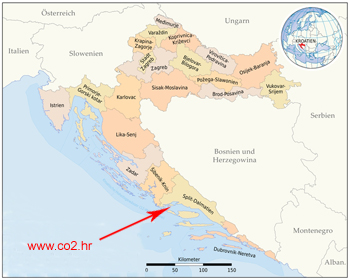
Croatia is the170th Country that has ratified the Kyoto Protocol on climate change - from June 2013 Croatia is a full member of the European Union and therefore subject to the emissions trading law
- Kyoto Protocoll Ratification:11/03/99
- Ratification Approval:30/05/07
- Entry into force:28/08/07
- Reduction goals:- 5%
(Annex B: Target 1990 - 2008/2012)
Based on Article 47 Paragraph 1 Law on Air Protection ("Official Gazette" no. 178/2004 and 60/2008), the Croatian Government at its session held on 26 June 2009. Adopted
Allocation OF GREENHOUSE GASES IN THE REPUBLIC OF CROATIA
First PURPOSE AND OBJECTIVES OF THE PLAN
The legal basis for adopting the Plan of Allocation of greenhouse gas emissions in the Republic of Croatia is contained in Article 47 Paragraph 1 Law on Air Protection ("People newspaper," no. 178/2004, 60/2008). The law regulates the basic elements of the Plan of Allocation of greenhouse gas (hereinafter referred to as Plan allocation).
Allocation plan based on a plan to protect and improve air quality in the Republic of Croatia for the period of 2008. - 2011. years ("Official Gazette" No. 61/2008) and the Energy Strategy ("Official Gazette" No. 38/2002), and the application of best available techniques.
Allocation plan includes: the total amount of emission allowances within the period specified by the state, information on past emissions of greenhouse gases, a list of activities that release greenhouse gases, annual allowances that are allocated for the plant, method of allocation of allowances of greenhouse gas plant operators, assessment of future emissions greenhouse gas emissions, the determination of reserve allowances for new installations, how to use the mechanisms of the Kyoto Protocol and time allocation of allowances to installations.
Among the Croatian obligations arising from the Kyoto Protocol, and the process of Croatian accession to the European Union (EU) is the transfer of the acquis communautaire in the field of climate change in the Croatian legislation:
– Directive 2003/87/EC establishing a system for trading emission allowance trading within the Community;
– Directive 2004/101/EC amending Directive 2003/87/EC establishing a scheme for trading greenhouse gas emission allowances within the Community, concerning the project mechanisms of the Kyoto Protocol;
- Decision 2007/589/EC establishing guidelines for monitoring and reporting of greenhouse gas emissions pursuant to Directive 2003/87/EC;
– La décision 2007/589/CE établissant des lignes directrices pour la surveillance et la déclaration des émissions de gaz à effet de serre conformément à la directive 2003/87/CE -;
– Decision 2005/381/EC establishing a questionnaire for the reporting requirements under Directive 2003/87/EC;
– Commission Regulation 2216/2004 on the standardized and secured system of registries pursuant to Directive 2003/87/EC and in accordance with Decision 280/2004/EC;
– Commission Regulation 916/2007 amending Commission Regulation 2216/2004 on the standardized and secured system of registries pursuant to Directive 2003/87/EC and in accordance with Decision 280/2004/EC;
- Commission Regulation 994/2008 on the standardized and secured system of registries pursuant to Directive 2003/87/EC and in accordance with Decision 280/2004/EC.
These acquis has been transposed into the Croatian legal system, the following rules::
- Regulation on the monitoring of greenhouse gases in the Republic of Croatia ("Official Gazette", No. 1/2007),
The adoption of this Plan allocation to fully complete the transposition of the acquis into Croatian legislation
Second STARTING POINTS AND PRINCIPLES FOR ALLOCATION greenhouse gas emission quotas Summary of the principle of allocation of allowances plants is shown in the following table:
| The starting point | Principle | Reference |
|---|---|---|
| Obligations of the Croatian arising from the Kyoto Protocol | Amount of greenhouse gas emissions in the base year for the Republic of Croatia amounted to 34.845 Mt CO2eq. Croatia has pledged to reduce by 5% compared to the base year, thus reaching the Kyoto target of 33.102 Mt CO 2 eq. | Decision 7/CP.12 Conference of the Parties United Nations Framework Convention on Climate Change (UNFCCC) and the draft report of the audit team of the UNFCCC - IAR (May 2009). |
| The national upper limit of emission quotas | The annual emission quota allocation amounts to a total of 13.310 Mt CO 2 eq, including a reserve for new entrants | Projections of emissions trading system based on data from the questionnaires, the macroeconomic projections in 2003. Mr. (National Report) |
| "Top-down" approach | The total quantity of allowances for allocation is determined by the "top-down" (from top to bottom) projections | |
| Data of previous years and forecasts | Allocation method is based on a combination of approaches based on historical data and access planning. The period since 2004. to 2007. the base year for CO2 emissions. | |
| The reference period and the relevant emissions | Previously a reference period is the period since 2004. to 2007. year. Relevant plant emissions are the average emissions of two years with the highest emissions during the reference period. | Projections of emissions trading system based on data from questionnaires |
| Two-stage approach | Allocation of allowances to installations performed in two steps. First, the emission allowances allocated to four sectors, and then plants within these sectors. | |
| Sectoral Approach | All plants are listed as defined in Directive 2003/87/EC establishing a scheme for trading greenhouse gas emission. National Allocation Plan distinguishes four groups of plants: power plants (thermal input> 20 MW) plants for the production of cement and lime, petrochemical plants and other facilities. The distribution of plants occurs in two steps. First, the emission allowances allocated to four sectors, and then plants within these sectors. | |
| Distribution by Sector | The distribution by sector is performed by taking into account the "top-down" approach to the projected emissions, which are based on data on emissions from the previous period, the projected growth of production and the anticipated reduction in emissions of carbon dioxide. | |
| Distribution of plants | Allocation of emission allowances at the installation level takes place on the basis of emissions from installations in the total emissions of the relevant sectors. | |
| Plants with incomplete data from previous periods | Evaluate the individual cases in order to determine the emission quotas plants whose data were incomplete in previous periods. Emission allowances will be allocated on the basis of reference values. | |
| Recent action and clean technology | Recent action and clean technology are not taken into account due to lack of data. | |
| The new entrants | Reserve of allowances for new entrants is 0.858 Mt CO2eq year. The reserve is based on known plans and projections. The new participant is considered a plant where the occupancy permit issued after the adoption of the Plan of Allocation of greenhouse gas emissions. | |
| Termination of the plant | Plant operators must notify the termination of the plant. Unused emission quotas are transferred to the reserve for new installations. | |
| The reserve for joint implementation projects | It is not anticipated requirement for joint implementation projects. | |
| Emission allowances resulting from the implementation of projects under the Kyoto Protocol | Plants are allowed to use emission reduction units (ERUs Eng.) and certified emission reduction units (CERs Eng.) in an amount of up to 15% of their emission allowances. | |
| Allocation | Allocation of emission allowances in a calendar year shall be awarded to 28 February | |
| The transfer of allowances in future periods "Banking" | Allows transfer of emission units in the period commencing from the 2013th year. | |
| Public auction | Quotas are based on this Plan allocated for free distribution. | |
| Emissions of other greenhouse gases (except CO2) | Besides CO2, other greenhouse gases are not included in the plan of distribution. |